
In the modern beauty industry, innovation moves fast. New active trends emerge overnight, and product launches are expected in months, not years. Speed, differentiation, and aesthetics dominate conversations across marketing teams and founder forums. Yet one discipline quietly decides whether that speed creates success or future failure: skincare stability testing.
Behind every product that succeeds long after launch is stability. It determines whether a formulation performs consistently from the first use to the very last drop. It defines how products respond to heat, humidity, transport, storage, and time itself. More importantly, stability protects consumer safety, brand credibility, and long-term business viability.
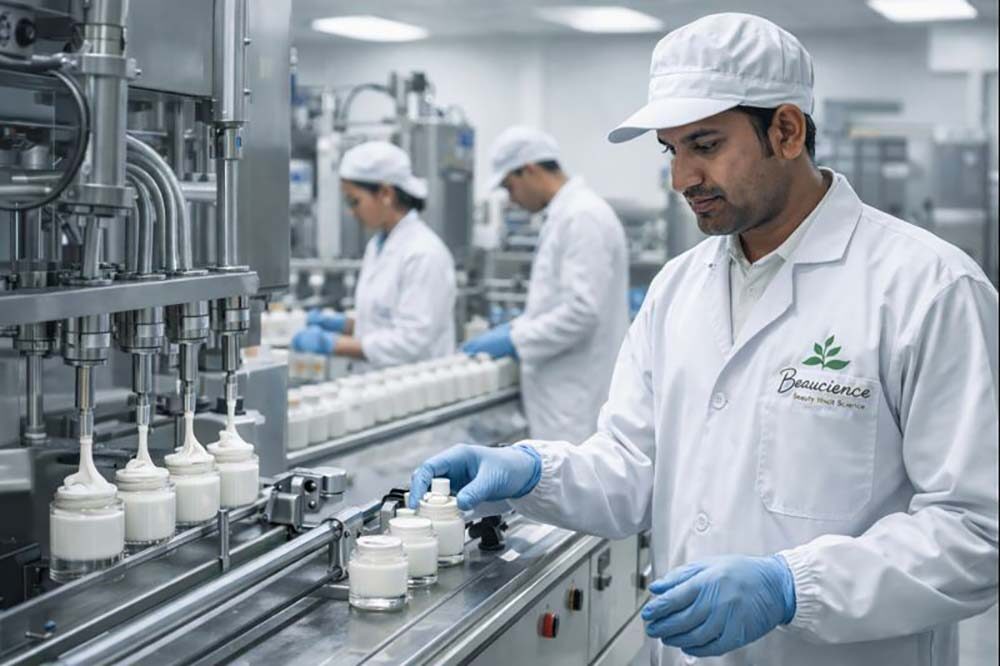
Having worked closely with formulation teams and private label skincare manufacturing partners, we have seen how often stability testing is treated as a formality. Something to complete quickly so a product can move to market. In reality, stability is not a regulatory afterthought. It is the foundation of responsible formulation and scalable beauty manufacturing.
This article explains why stability testing is a leadership decision, not a lab checkbox, and how brands that design stability early build products meant to last, scale, and earn trust.
Also Read:
- The Ultimate Men’s Care Guide: Benefits and Routine Tips
- Designing Scale-Ready Skincare from Day One
What Skincare Stability Testing Really Means
Skincare stability testing evaluates whether a cosmetic formulation maintains its physical, chemical, microbiological, and functional integrity throughout its intended shelf life. It is the process that determines whether a product remains dependable not just at launch, but months later under real usage conditions.
In practical terms, stability testing answers one essential question: will this product remain safe, effective, and consistent under real-world conditions where temperature, handling, and storage are not controlled?

Why Real-World Conditions Matter More Than Lab Perfection
Stability testing considers not only time, but stress. Products are evaluated under varying temperatures, humidity levels, and storage conditions to simulate what actually happens once they leave the manufacturing facility. This becomes especially critical in a globally distributed beauty market where products move across hot, humid, and cold environments before reaching consumers.
A stable product retains its texture, color, fragrance profile, pH, and performance over time. It does not separate, degrade, or lose efficacy as months pass. It also remains microbiologically safe, ensuring that preservatives continue to protect the formulation throughout its lifecycle, not just at the point of manufacture.
Without proper skincare stability testing, a formulation that appears perfect at launch can quietly deteriorate long before its expiration date, creating quality risks that surface only after the product is already in consumers’ hands.
Why Stability Is More Than Regulatory Compliance
Many beauty brands assume stability testing exists mainly to satisfy regulations. Compliance may allow a product to launch, but stability determines whether it can survive real use, time, and consumer scrutiny.
Stability testing protects brands from risks that compliance checks alone do not uncover:
- Delayed formulation failure that appears months after launch, not during approval
- Texture, odor, or color drift that damages consumer confidence over repeat use
- Active ingredient degradation that reduces efficacy without obvious warning signs
- Preservative stress and microbial risk emerging under heat, humidity, or transport conditions
- Batch inconsistency across shelf life leading to uneven customer experience
- Reputational damage and returns that cost far more than early testing investment
Stability functions as long-term risk management, not paperwork. It prevents quiet failures that erode trust slowly and are difficult to reverse once products are already in the market.
What Happens When Stability Is Rushed or Overlooked
Instability rarely announces itself at launch. It develops quietly and gradually, often going unnoticed until products are already in the market and consumer feedback begins to surface. By then, the damage is harder to contain.
Early Physical and Sensory Breakdown
One of the most common signs of instability is phase separation, where creams and lotions split into oil and water layers. This often appears weeks or months after production, especially when products face fluctuating temperatures during storage or transport.
Texture drift is another frequent issue. A formulation that initially feels smooth and elegant may become thick, grainy, or watery over time. These changes alter the user experience and reduce perceived quality, even when safety is not immediately compromised.
Chemical and Microbial Degradation Risks
Color and odor changes are strong indicators of deeper instability. Oxidation of oils, botanical extracts, or active ingredients can cause discoloration or unpleasant smells, signalling chemical degradation within the formula.
When Preservative Systems Are Put Under Stress
In more serious cases, preservative systems may fail under prolonged heat, humidity, or storage stress. This can allow microbial growth even if initial challenge tests were passed, creating safety risks that emerge only after wide distribution.
These issues often trace back to development shortcuts. Brands under pressure to launch quickly may rely only on short-term accelerated testing or assume early visual stability guarantees long-term performance. Once instability appears in the market, corrective action becomes limited, expensive, and reputationally damaging.
Stability problems are far easier, faster, and less costly to prevent during development than to fix after products reach consumers.
Why Modern Beauty Brands Face Greater Stability Challenges
Stability challenges today are more complex than they were even a decade ago. Modern beauty formulations are richer, more active-driven, and significantly more sensitive to environmental stress than earlier generations of products.
Global Distribution and Environmental Stress
Global distribution is one of the biggest contributors to modern stability risk. Products are no longer sold in a single region with predictable storage conditions. They travel through hot and humid climates, cold warehouses, long shipping routes, and uncontrolled transport environments. Each transition introduces thermal and mechanical stress that can compromise formulation integrity long before the product reaches the consumer.
Ingredient Complexity and Compressed Timelines
Ingredient complexity has increased sharply. High-performance actives, botanical extracts, ferments, and encapsulated systems deliver visible results but often have narrower stability margins if not engineered correctly. At the same time, the industry’s shift toward clean, minimalist, or low-preservative formulations places greater responsibility on formulation science to maintain safety and performance.
Compressed launch timelines further magnify these risks. Speed-to-market pressures can push stability testing into a secondary role, even though the long-term consequences of instability are far more damaging than a delayed launch.
In this environment, stability is no longer a technical detail. It is a strategic necessity that directly affects product longevity, brand trust, and the ability to scale responsibly.
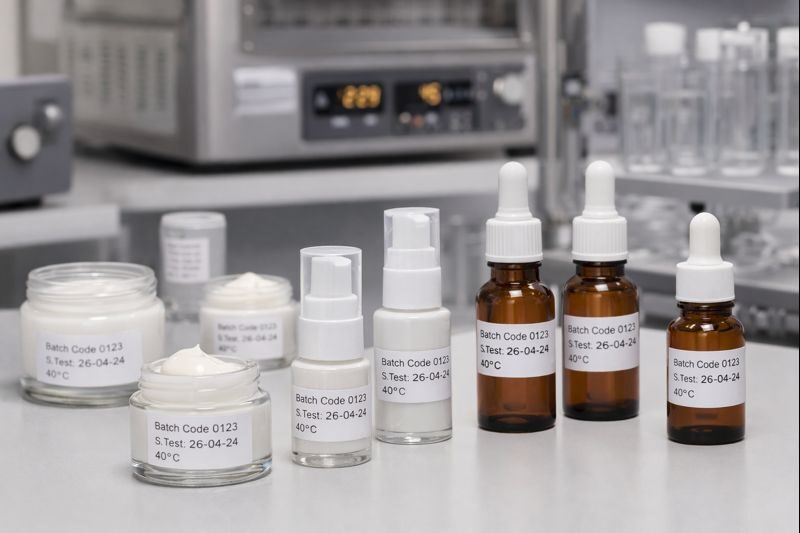
Understanding Accelerated and Real-Time Stability Testing
Stability testing is not a single process. It is a combination of complementary approaches designed to predict how a product will behave over time, under both stress conditions and normal storage environments. Each method serves a distinct purpose.
Accelerated Stability Testing
Accelerated stability testing is used to identify early formulation weaknesses by exposing products to elevated stress conditions. By subjecting formulations to higher temperatures and humidity, this method simulates aging in a shorter time frame and highlights potential risks early in development.
This approach helps identify issues such as emulsion breakdown, texture instability, color or odor changes, and preservative stress before a product reaches the market. It is especially useful during formulation development, optimisation, and reformulation stages, where rapid feedback is critical.
However, accelerated testing has clear limitations. It cannot fully replicate real-world aging patterns or long-term ingredient degradation that occur under normal storage conditions.
Real-Time Stability Testing
Real-time stability testing evaluates products under standard storage conditions across extended periods. It monitors product performance over months or years, validating shelf-life claims and confirming long-term safety, efficacy, and sensory consistency.
This method is essential for identifying gradual changes that heat-based testing may miss, particularly in complex or active-driven formulations.
Best Practice Approach for Reliable Stability Outcomes
For dependable results, responsible beauty brands combine both methods. Accelerated testing is used for early risk detection, while real-time testing validates long-term performance. Relying on accelerated testing alone significantly increases the risk of post-launch instability and late-stage quality failures.
Packaging Compatibility: The Overlooked Stability Factor
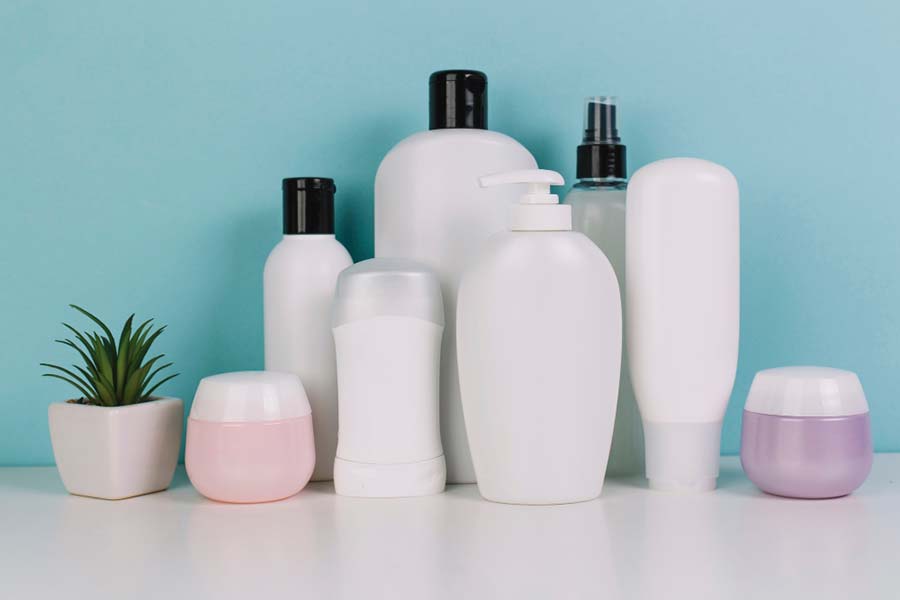
Stability does not depend on formulation alone. Packaging plays a critical role in how a product performs over time, especially once it enters real-world storage, transport, and daily consumer use.
Many stability failures occur not because of the formula itself, but because the container interacts negatively with it over time.
How Packaging Can Impact Stability
Packaging can compromise formulation integrity in multiple, often overlooked ways:
- Absorption of oils or actives by plastic components, reducing product efficacy
- Chemical leaching from packaging materials into the formulation over time
- Increased air exposure caused by poor seals, leading to oxidation
- Mechanical failures in pumps, droppers, or closures affecting dosing and hygiene
- Loss of product integrity during repeated opening, closing, and handling
These issues may not appear during early testing but often surface after distribution begins.
Why Packaging Compatibility Testing Matters
Packaging compatibility testing evaluates how the formulation and container perform together across the product’s full shelf life:
- Ensures texture, color, and efficacy remain consistent
- Confirms packaging materials do not compromise safety
- Prevents late-stage failures after commercial launch
At Beaucience, packaging is assessed as part of the formulation system, not as an afterthought. A product is considered stable only when both the formula and its packaging perform reliably together over time.
Stability Is a Design and Leadership Responsibility
Stability is not only a technical concern. It is inseparable from microbial safety, formulation design, and leadership judgment. A product may look, smell, and feel stable while still posing safety risks if its preservative system degrades over time.
Stability and Microbial Safety Are Inseparable
Preservatives must remain effective throughout the entire shelf life of a product, not just at the point of manufacture. Stability testing evaluates preservative performance under stress conditions such as heat exposure, freeze-thaw cycles, and extended storage. This ensures continued protection against bacteria, yeast, and mold long after launch.
For water-based and clean-label formulations, this balance becomes even more delicate. Testing safeguards consumer health and regulatory compliance by verifying that microbial control remains intact under real-world conditions.
Stability Must Be Designed and Led From the Start
Remember stability cannot be added at the end of development. It must be built into the formulation from the earliest concept stage. Ingredient selection, emulsion systems, pH optimization, preservative strategy, and manufacturing parameters all influence long-term performance.
At Beaucience, stability is considered a leadership decision as much as a laboratory process. Founders and decision-makers shape stability outcomes through the timelines they set, the partners they choose, and the importance they place on long-term quality. Brands that prioritise stability early build products designed for scale, repeat purchase, and enduring trust.

Conclusion: Stability Defines Long-Term Brand Success
In modern beauty, products rarely fail on launch day. They fail quietly over time, through inconsistency, safety risks, and loss of consumer trust. Skincare stability testing prevents that erosion. It protects performance across beauty product shelf life, safeguards microbial safety, and preserves brand credibility as products scale across markets. For brands focused on responsible growth and global readiness, stability is not optional. It is foundational.
At Beaucience, cosmetic stability testing is designed from the start, not tested at the end. Our approach integrates formulation science, packaging compatibility testing, and manufacturing discipline to ensure products perform reliably in real conditions. Because in private label skincare manufacturing, lasting brands are not defined by speed or aesthetics alone, but by products that remain safe, consistent, and dependable long after launch.
Partner with Beaucience to build stability-led formulations engineered for scale, safety, and longevity. Start your next product with science-first design, rigorous testing, and manufacturing clarity.