
Many consumers begin using retinol, experience a few weeks of peeling or sensitivity, and quickly conclude that the ingredient is harmful. The question, does retinol thin skin, continues to influence buying decisions despite decades of clinical evidence supporting retinoids as some of the most researched actives for skin renewal and skin barrier health.
At Beaucience India, we work with private label brands to develop retinoid-based skincare products across categories and consumer needs. In our experience, concerns around retinol rarely stem from the ingredient itself. They are more often linked to retinol concentration, stability, and formulation design.
The real challenge is that temporary adaptation is still widely confused with lasting damage. Without clear communication and thoughtful formulation, outdated beliefs continue to shape consumer perceptions.
In this article, we explore where the retinol myth originated, what clinical evidence reveals about skin structure. How formulation architecture and manufacturing discipline turn retinoid tolerance into an engineered outcome rather than a consumer gamble.
Also Read:
- New Product Development in 2026: 5 Beauty Shifts Brands Cannot Ignore
- pH Balanced Skincare: Why Formulation Balance Defines Results
- Fermented Skincare and the Future of Beauty Formulation
Does Retinol Thin Skin? Where the Myth Actually Comes From
The belief that retinol thins skin did not emerge from clinical research. It grew from early consumer experiences and limited understanding of how retinoids function within modern skincare formulations.
How Early Retinoid Use Created the Thinning Narrative
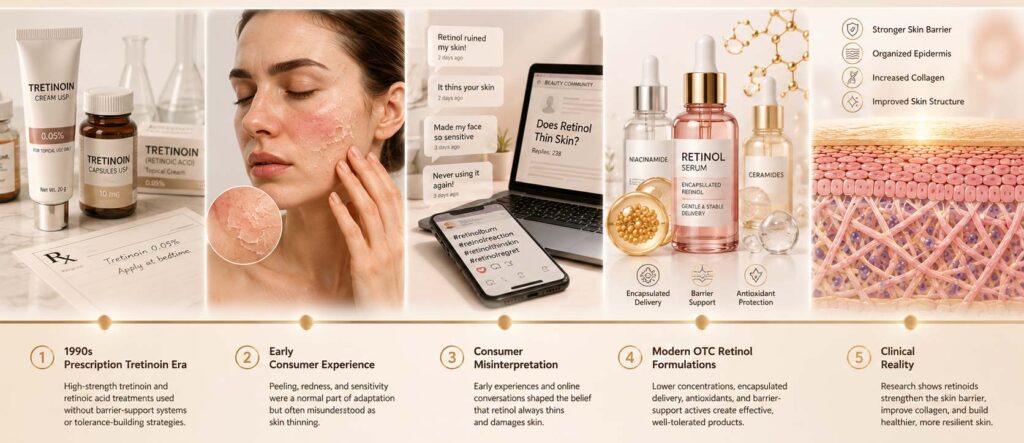
Prescription-strength tretinoin was among the earliest retinoids used widely in skincare. It was applied at higher concentrations and frequencies than most OTC retinol products and without the tolerance-support systems used today.
Peeling, redness, and sensitivity were often interpreted as skin thinning rather than the natural increase in skin cell turnover taking place during adaptation. Those early experiences shaped public perception long before barrier-supportive formulations became standard practice.
When OTC retinol entered the market, it inherited this reputation despite using lower concentrations and gentler delivery systems. The ingredient carried the legacy of prescription use even when the formulations were entirely different.
The Difference Between Retinol Irritation and Skin Damage
Retinol irritation is a temporary response involving mild skin barrier disruption and accelerated skin cell turnover. With appropriate formulation support, this adjustment phase resolves within a few weeks for most users.
Permanent damage is fundamentally different. When retinol concentration and barrier-supportive ingredients are balanced correctly, clinical evidence shows stronger, more resilient skin rather than epidermal thinning.
The persistence of this myth reflects a communication gap as much as a formulation challenge. Better education and better products are both essential to changing consumer perceptions.
Clinical Evidence Shows Retinoids Strengthen Skin Structure
Clinical evidence consistently contradicts the belief that retinoids thin the skin. Sustained, well-formulated use supports both epidermal organisation and long-term dermal resilience.
Structural Benefits of Retinoid Activity
Retinol converts to retinoic acid within the skin, regulating processes linked to repair, renewal, and collagen production. The documented structural changes point in the opposite direction of the thinning narrative.
- Increased dermal collagen: Supports firmer, stronger skin and improves long-term structural resilience.
- Improved epidermal organisation: Creates a healthier skin barrier through better keratinocyte arrangement and function.
- Enhanced filaggrin activity: Strengthens natural moisturising factors and supports overall barrier integrity.
Retinisation and Barrier Adaptation
Retinisation is the adjustment phase during the first few weeks of retinoid use. Temporary changes during this period reflect adaptation, not structural damage to the skin.
- Accelerated skin cell turnover: Promotes renewal and replaces irregular surface cells with healthier ones.
- Temporary retinol irritation: Mild redness and peeling usually resolve as the skin adapts to treatment.
- Barrier-supportive formulations: Appropriate concentrations and complementary ingredients improve comfort and long-term tolerance.
Clinical evidence remains clear. Properly formulated retinoids strengthen skin structure, and formulation discipline plays a critical role in delivering those outcomes.
Formulation Architecture Determines How Retinol Performs
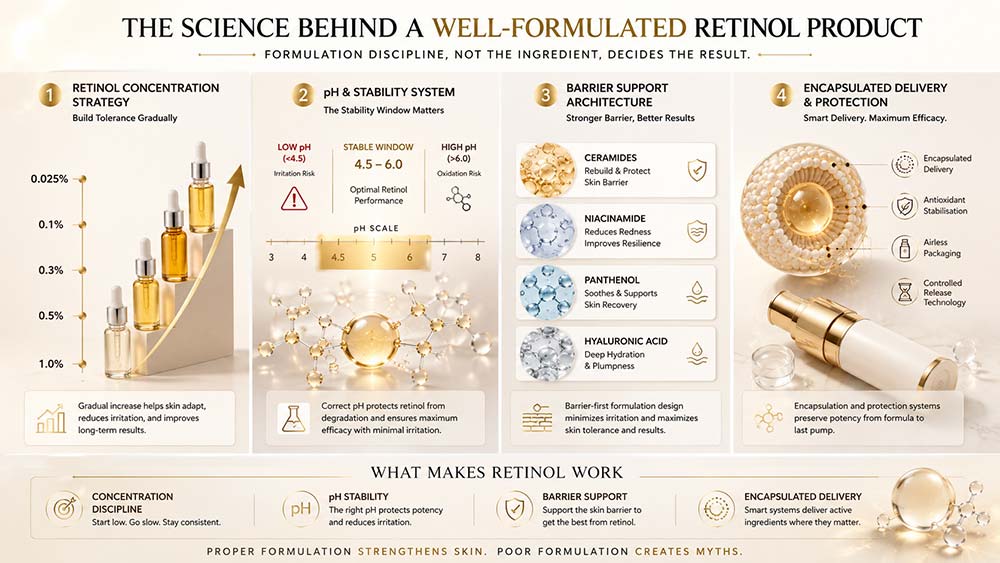
The performance of a retinoid product depends on more than the active ingredient itself. Retinol concentration, pH stability, antioxidant protection, and barrier support collectively determine whether the experience builds confidence or creates irritation.
Concentration Strategy and Barrier-Supportive Formulation
Effective retinol products are designed around gradual adaptation rather than maximum potency. Introductory formulations typically begin at lower concentrations, allowing the skin to build tolerance before moving to stronger systems.
Retinol also requires a stable pH environment, generally between 4.5 and 6.0, to balance efficacy with tolerability. Antioxidants such as tocopherol and protective packaging systems help preserve active integrity throughout the product’s shelf life.
Barrier-supportive ingredients remain equally important:
- Ceramides: Reinforce the lipid matrix during periods of increased skin turnover.
- Niacinamide: Supports ceramide production and helps reduce visible retinol irritation.
- Panthenol: Promotes epidermal recovery and improves overall product tolerance.
Why Does Barrier Support Matter in Retinol Formulations?
Barrier-supportive ingredients help the skin adapt to retinoid activity without excessive irritation. They improve comfort, strengthen resilience, and make consistent long-term use more achievable for different skin types.
Formulation architecture ultimately determines the outcome. Retinol concentration, pH management, antioxidant stability, and barrier support are not secondary considerations. They form the foundation of an effective retinoid product.
How Beaucience Builds Retinol Tolerance Into Formulation Design
At Beaucience, retinol tolerance is engineered at the formulation stage, not left to consumer trial and error. Our approach combines stability science, barrier support, and compatibility testing to deliver retinoid products that perform consistently across different sensitive skin profiles and consumer needs.
- Encapsulated retinol systems: Microencapsulation and lipid delivery technologies release retinol gradually, reducing irritation while maintaining consistent activity throughout the product lifecycle.
- Graduated retinol concentration: We help brands build stepped retinoid ranges that allow consumers to progress through different strength levels as their skin adapts over time.
- Antioxidant stabilisation protocols: Retinol requires validated antioxidant systems and protective packaging to preserve potency from manufacturing through the end of shelf life.
- Compatibility with barrier actives: Niacinamide, ceramides, and peptides are tested for stability and performance at target pH levels before formulations move to commercial production.
- Irritation and tolerance testing: Stability studies, patch assessments, and in-use evaluations support retinoid claims with greater confidence and consumer trust.
Retinol tolerance should not be a consumer responsibility alone. At Beaucience, it is treated as a formulation and manufacturing outcome designed to deliver safer, more consistent long-term performance.
Also Read:
The Myth Ends Where Formulation Begins
The answer to does retinol thin skin is clear when formulation science is applied correctly. Retinol concentration, pH stability, antioxidant protection, and skin barrier support determine how the ingredient performs over time. Clinical evidence consistently shows that properly formulated retinoids strengthen skin structure rather than weaken it.
The adaptation period associated with retinoid use is real, but it is temporary and predictable. When supported by barrier-friendly ingredients and well-designed delivery systems, retinol irritation becomes manageable without compromising long-term efficacy. Strong formulation architecture allows consumers to experience the benefits of retinol with greater confidence and consistency.
At Beaucience, we help private label brands develop retinoid products backed by formulation discipline, stability testing, and consumer-first design. Partner with us to create skincare solutions that build skin strength, trust, and long-term brand credibility.
Our Digital Imprints:
Discover the power of personalized skincare with Beaucience India. We offer premium private label skincare products and services designed for established brands, physicians, estheticians, and skincare professionals.
Beaucience is dedicated to helping brands like yours thrive in the skincare market. If you’re ready to explore custom formulations that set your products apart, we invite you to reach out and learn more about our capabilities.
Our commitment to quality ensures exceptional results tailored to your needs. Stay updated with the latest trends and insights in the beauty and cosmetic industry by subscribing to our newsletter.
“Beauty Alchemist” on Beauty and Cosmetic Industry
Join our community on : Instagram | Facebook | LinkedIn
Transform your skincare vision with Beaucience India today!