
Riya spends ten minutes every morning layering serum, moisturiser, and sunscreen on her face. For her body, she still reaches for one basic lotion after a shower. That contrast explains why body skincare is now moving beyond simple moisturisation.
The shift is already visible in the market. India’s body care category recorded an 8.02% CAGR from 2019 to 2024, reaching INR 21.91 billion in sales in 2024. The category’s growth reflects a broader shift in body care, as consumers increasingly look beyond basic moisturisation toward more specific skin concerns.
At Beaucience, we see this shift directly through our formulation work. Our in-house R&D team develops private label body care through custom formulation and stability testing. We also focus on ingredient selection and sensory development for larger, more varied skin surfaces.
In this edition, we’re breaking down why high-performance body care depends on matching real consumer concerns with the right actives, delivery systems, skin barrier support, and sensory experience, rather than simply developing a heavier moisturiser.
Also Read:
- Why More Skincare Actives Do Not Mean Better Results
- Refillable Skincare: Formulation Before Packaging
Body Skincare Requires Its Own Formulation Logic
Body skincare needs its own formulation logic because body skin varies by site, thickness, oil activity, friction, and surface area. These differences affect product format, application, and performance.
Body skincare cannot simply copy facial skincare. Formulators must account for regional differences in stratum corneum thickness, sebaceous activity, follicular density, application area, and consumer use. These factors influence active selection, spreadability, absorption, tolerability, and the consistency of product performance.

Concern-Specific Body Care Is Replacing Generic Hydration
For years, moisturising was the main brief for body products. That is changing. Consumers now expect body moisturisers and body serums to address skin texture, rough patches, uneven tone, breakouts, and other defined concerns.
This shift is making targeted body care more relevant across product development. A heavy emollient base may support dryness, but it cannot answer every concern. Formulators need to match the product format, active system, and sensory profile to the intended use instead of treating hydration as the complete solution.
Body Skin Differences Change Formulation Decisions
Body skin is not uniform. Areas such as elbows and heels generally have a thicker stratum corneum than the inner arm, while sebaceous activity and follicular density also vary across sites. These differences can affect how a body care formulation spreads, feels, and delivers its intended cosmetic benefit.
Application behaviour adds another variable. Consumers usually cover larger areas and use more product than they would on the face. Spreadability, absorption speed, residue, active distribution, and tolerability therefore need to be considered from the first formulation stage.
Body care formulation is not facial skincare in a larger bottle. Stronger products begin with the biology of the application site, the consumer concern, and the way the formula will actually be used every day.
Targeted Body Care Matches Formulas to Real Skin Concerns
Targeted body care starts by identifying the concern first. Texture, pigmentation, breakouts, dryness, and visible ageing each demand different formulation choices rather than one universal moisturising approach.
Consumer Concerns Are Becoming More Specific
Consumers increasingly recognise body concerns with the same detail they apply to facial skincare. That is pushing brands beyond generic hydration claims toward more focused solutions.
- Texture and rough patches: Keratosis pilaris, dry patches, and rough elbows often need body exfoliation and hydration support rather than a basic lotion alone.
- Body pigmentation: Friction, sun exposure, and ingrown hairs can contribute to uneven-looking tone on areas such as knees, elbows, and underarms.
- Barrier discomfort: Persistent dryness may also signal weakened barrier function, making skin barrier support an important part of the formulation brief.
Body Care Actives Need Concern-Led Selection
Body care actives should be chosen around the intended concern, application site, product format, and tolerability. Facial skincare concentrations should not simply be transferred to body products.
- For texture: Urea and exfoliating acids can support smoother skin when concentration and tolerability are carefully balanced.
- For uneven tone: Niacinamide and suitable brightening actives can support body pigmentation concerns within a well-designed formula.
- For breakouts and ageing: Salicylic acid may support body breakouts, while barrier-supportive and antioxidant systems can address broader visible skin ageing concerns.
Matching concerns with appropriate actives, delivery, and sensory design gives brands a stronger body care formulation strategy. It also creates more meaningful differentiation than another all-purpose moisturiser on the shelf.
Skin Barrier Support Strengthens Active Performance
Skin barrier support is the foundation of effective body care formulation. When the barrier is compromised, moisture loss and sensitivity can increase, making it harder to maintain comfort and consistent product performance.
Barrier Support Begins Inside the Formula
A weakened skin barrier can increase transepidermal water loss and leave body skin feeling dry, tight, or reactive. Barrier support therefore needs to be considered from the first formulation stage, rather than added later as a marketing claim.
Ingredients such as ceramides and other lipid-replenishing components can help support the skin’s protective structure. Gentle surfactant systems also matter in rinse-off products because repeated cleansing can affect barrier comfort when the system is too harsh.
How Do Active Delivery Systems Improve Body Care Performance?
Active delivery systems help improve the stability, dispersion, release, and availability of ingredients within a formulation. Encapsulation and emulsion design can support more consistent delivery while also helping formulators manage compatibility, sensory feel, and performance across different body care formats.
Barrier support and active delivery systems work best as part of the same formulation strategy. When both are considered together, brands can build body products that support comfort, ingredient performance, and consistent everyday use.
Sensory Performance Drives Body Care Repurchase
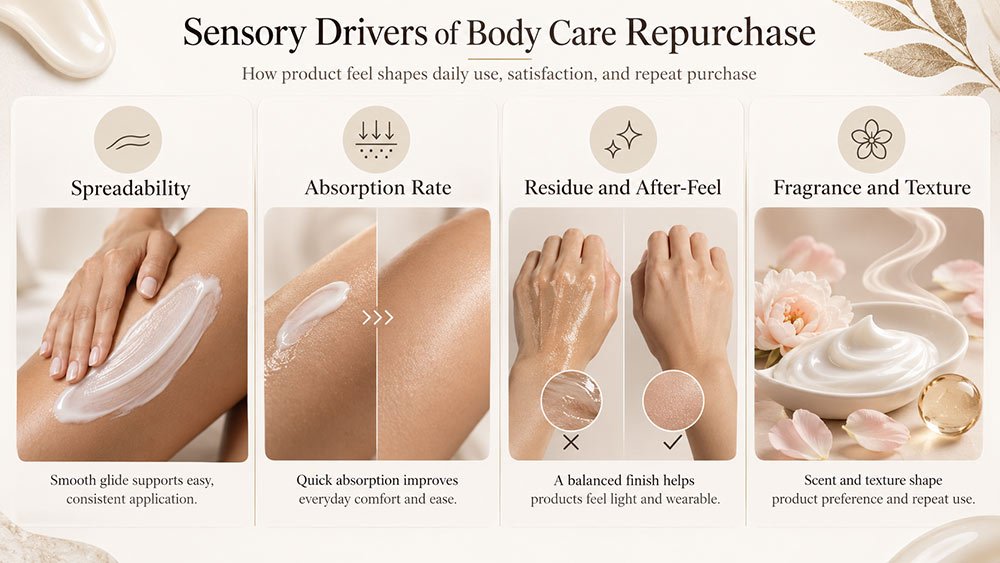
Sensory performance shapes whether consumers keep using a product after the first few applications. In body skincare, texture, absorption, residue, and fragrance all influence comfort, consistency, and repeat use.
- Spreadability: Body moisturisers cover larger areas than facial products. A formula that drags, pills, or spreads unevenly can discourage regular and generous application.
- Absorption rate: Consumers expect body lotions and body serums to absorb quickly enough for everyday routines. Slow absorption can make dressing uncomfortable and reduce product appeal.
- Residue and after-feel: Heavy, greasy, or tacky residue can affect the overall product experience. A balanced finish helps the formula feel comfortable across larger skin surfaces.
- Fragrance and texture: Scent, richness, glide, and finish shape how consumers experience a formulation. These sensory cues can strongly influence perceived quality and product preference.
Sensory design is therefore part of product performance, not an added finishing detail. When efficacy and sensory experience work together, body care is easier to use consistently and more likely to become part of a daily routine.
Also Read:
- Fermented Skincare and the Future of Beauty Formulation
- Why Multifunctional Skincare Works Only When Formulation Supports Every Claim
Final Thoughts
High-performance body skincare is no longer a basic moisturising category. Consumers now expect targeted body care that addresses texture, uneven tone, breakouts, dryness, and visible ageing with greater precision.
Meeting those expectations requires thoughtful body care formulation, skin barrier support, appropriate active delivery systems, and sensory performance that works in everyday use. Each element needs to support the others.
For brands ready to expand, private label body care creates a clear opportunity to build differentiated products around real consumer concerns, stronger formulation logic, and consistent product experience.
Partner with Beaucience to develop high-performance body care formulations built around science, sensory experience, stability, and the needs of your brand.
Our Digital Imprints:
Discover the power of personalized skincare with Beaucience India. We offer premium private label skincare products and services designed for established brands, physicians, estheticians, and skincare professionals.
Beaucience is dedicated to helping brands like yours thrive in the skincare market. If you’re ready to explore custom formulations that set your products apart, we invite you to reach out and learn more about our capabilities.
Our commitment to quality ensures exceptional results tailored to your needs. Stay updated with the latest trends and insights in the beauty and cosmetic industry by subscribing to our newsletter.
“Beauty Alchemist” on Beauty and Cosmetic Industry
Join our community on : Instagram | Facebook | LinkedIn
Transform your skincare vision with Beaucience India today!