
A dermatologist opens a new batch of a product she has prescribed for months. The label is the same. The formula claims are the same. But the texture feels slightly different. In clinical skincare, that small shift is not cosmetic. It raises doubt.
The global professional skincare market is growing steadily, yet clinics report that consistency matters more than novelty. In my experience working with brand founders and dermatology-led teams, the real challenge is not launching a product. It is protecting product stability and batch consistency long after launch.

At Beaucience India, we approach clinical skincare as a scientific discipline, not a marketing label. With ISO-certified facilities, in-house R&D, and stability-driven private label manufacturing systems, our focus remains on predictable performance across production cycles and scale.
This article explores why clinical credibility is built slowly through formulation restraint, validation rigor, and manufacturing judgment—and why cutting corners quietly erodes trust, practitioner confidence, and long-term brand value.
Also Read:
- Waterless Skincare Formulations: A Guide for Sustainable Beauty Brands
- FDA Approved Formulations: The Beaucience Standard for Premium Skincare
Why Formulation Discipline Determines Clinical Skincare Credibility
Clinical skincare is defined by formulation discipline because product stability and batch consistency determine long-term credibility in dermatology skincare environments. Claims alone cannot sustain professional trust.
Process Control Over Marketing Claims
Clinical credibility begins with process control, not endorsements. In dermatology skincare, even small shifts in absorption or tolerance affect practitioner confidence and treatment continuity.
Formulation discipline requires defined stability margins, controlled ingredient selection, and validated production parameters. Without these controls, product stability weakens and variability increases across batches.
Batch Consistency in Real-World Use
Batch consistency is the operational proof of clinical skincare integrity. If a product behaves differently across production cycles, credibility erodes quietly in professional settings.
Predictable performance allows clinics to integrate products into structured protocols without hesitation. When consistency holds, trust strengthens. When variability appears, confidence declines.
What Makes Clinical Skincare Different from Regular Skincare?
Clinical skincare is different because it prioritizes product stability, batch consistency, and predictable performance in dermatology settings over trends, rapid reformulation, or marketing claims.
Unlike consumer products, clinical skincare must perform consistently across production cycles and controlled clinical use. Even minor shifts in texture, tolerance, or absorption can disrupt treatment continuity. That is why formulation validation, stability margins, and disciplined private label manufacturing systems define true clinical credibility.
In dermatology skincare environments, reliability is not a preference. It is a professional requirement. Products are integrated into structured protocols where performance must remain repeatable over time.
Clinical skincare differs from regular skincare because it is built on controlled variability, validated systems, and long-term manufacturing discipline rather than speed, seasonal updates, or claim-driven positioning.
How Cutting Corners Undermine Clinical Skincare Credibility
Clinical credibility rarely collapses in a visible or dramatic way. Instead, quality slips away bit by bit when teams chase speed at the expense of stability. Every time someone cuts corners on validation, small problems start to creep in. At first, it is barely noticeable. But after a few rounds of clinical use, those inconsistencies show up. The effect of these shortcuts is revealed over a period of time.
Reduced Validation Discipline
When teams lower validation standards or rush the stability studies, the whole foundation of the formulation starts to crack. Such decisions may never result in complete formulation failure, but controlled variability gradually becomes noticeable over increased formulation batches during extended use. Clinical product stability depends on disciplined verification at every stage of development and scale-up.

In dermatology-backed skincare, even subtle inconsistency affects practitioner confidence. Ultimately, over time, any such reformulation or corrective adjustments can signal instability.
Common compromises that create variability:
- Compressed Timelines: Launch schedules accelerated by these methods can be risky for formulation stability.
- Lower stability margins: Narrow testing parameters result in batch-to-batch inconsistency.
- Reformulation cycles: Post-launch adjustments weaken professional skincare credibility and practitioner trust.
Clinical trust declines when shortcuts reduce validation discipline. Even small compromises in development or stability parameters introduce variability that weakens clinical consistency and long-term practitioner confidence.
Clinical Skincare vs Consumer Skincare: Why Stability Matters More Than Speed
Consumer skincare might be primarily targeting instant results and quick innovation, whereas clinical, grade skincare is based on a completely different concept. In professional environments, long-term predictability and controlled performance are valued more than intensity or trend alignment. The distinction becomes clear when evaluating how stability is treated across categories.
Why Stability Defines Clinical Products
Product stability in a clinical sense is the ability of the product to behave consistently from batch to batch, environment to environment, and from a long-term usage point of view. In the realm of dermatology-based skincare, inconsistency is not a viable option for faster results. Dermatologists need a predictable response for integration into a treatment plan.
Consumer-grade products may tolerate frequent updates or minor formulation shifts. Clinical environments cannot. Consistency over time supports repeat use safety and preserves formulation credibility. When stability is maintained, professional skincare earns long-term trust rather than short-term attention.
Key differences between clinical and consumer performance:
- Consistency over peak: Dependability matters more than rapid success.
- Batch-to-batch predictability: Stable production is one of the main conditions for dependable performance.
- Long-term use focus: The value of sustained results over trend, driven reformulations.
Clinical product stability is all about predictable, repeatable outcomes rather than fast or dramatic results. A true clinical reliability is a result of not only time but also batch consistency.
Why Clinics and Dermatology-Led Brands Cannot Tolerate Variability
In clinical environments, products are not standalone purchases. They are integrated into structured treatment plans where consistency supports both safety and outcomes. Even minor formulation variability can disrupt protocols and affect practitioner confidence. For clinics, variability is not a cosmetic issue. It is a professional liability.
Variability as a Clinical Risk
Dermatology-backed skincare has to do the same job every time. Practitioners rely on predictable performance. When texture, absorption, or skin tolerance shifts from one batch to another, trust gets shaky. That kind of hesitation doesn’t just slow things down; it can break the chain of care and push clinics to look elsewhere.
Consistency in clinical properties is essential for maintaining the reliability of clinical results. Over time, that uncertainty reduces trust and limits integration into advanced skincare programs.
What variability disrupts in clinical settings:
- Treatment continuity: If product behavior changes, protocols need to be reworked.
- Professional confidence: Practitioners hesitate when they can’t count on the same results.
- Brand credibility: Long-term use drops off if consistency isn’t guaranteed.
Variability disrupts treatment stability and makes practitioners lose trust. Consistency in treatment is crucial because even minor inconsistencies can influence treatment outcomes and professional confidence.
Why Manufacturing Discipline Protects Clinical Skincare Credibility
Clinical skincare credibility depends on manufacturing discipline because product stability must remain intact across scale, pressure, and repeated production cycles.
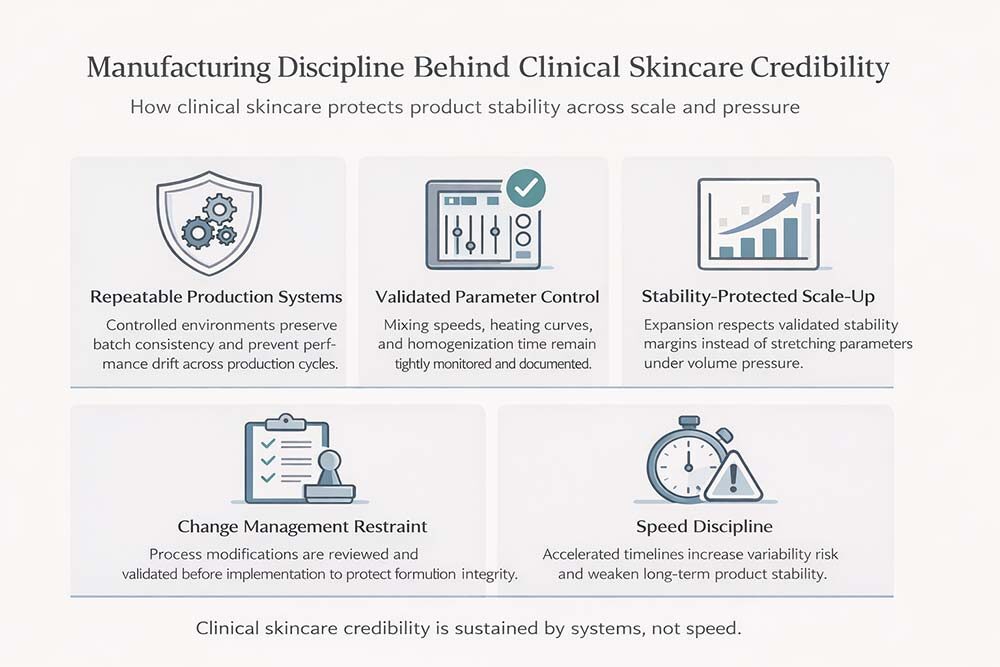
Private label manufacturing at clinical standards requires controlled systems that preserve validated formulation parameters.
What sustains clinical skincare manufacturing integrity:
- Repeatable production systems: Controlled environments maintain batch consistency and prevent unnoticed performance drift across production cycles.
- Validated parameter control: Mixing speeds, heating curves, homogenization time, and filling conditions remain documented and tightly monitored.
- Stability-protected scale-up: Expansion respects tested margins instead of stretching limits under commercial volume pressure.
- Change management restraint: Process modifications are controlled, reviewed, and validated before implementation.
- Speed discipline: Accelerated timelines increase variability risk and weaken long-term product stability.
Manufacturing judgment ultimately determines whether clinical skincare maintains predictable performance at scale or quietly loses credibility through accumulated variability.
Also Read:
Conclusion
Clinical skincare is not defined at launch. It is sustained through formulation discipline, validation judgment, and manufacturing stability over time. Claims may create visibility, but clinical credibility is built through repeatable outcomes and controlled variability.
At Beaucience India Private Ltd., clinical consistency is approached as a long-term responsibility, not a marketing position. From the development of disciplined formulation practices to the delivery of stability-focused private label skincare manufacturing services, all of these help deliver predictable performance in professional settings.
For skincare brands that have the backing of the dermatology community, the key differentiator is not speed but reliability. Clinical trust is earned through systems that prioritize stability over shortcuts and judgment over acceleration.
Our Digital Imprints:
Discover the power of personalized skincare with Beaucience India. We offer premium private label skincare products and services designed for established brands, physicians, estheticians, and skincare professionals.
Beaucience is dedicated to helping brands like yours thrive in the skincare market. If you’re ready to explore custom formulations that set your products apart, we invite you to reach out and learn more about our capabilities.
Our commitment to quality ensures exceptional results tailored to your needs. Stay updated with the latest trends and insights in the beauty and cosmetic industry by subscribing to our newsletter.
“Beauty Alchemist” on Beauty and Cosmetic Industry
Join our community on : Instagram | Facebook | LinkedIn
Transform your skincare vision with Beaucience India today!