
Serum labels now list five, seven, even eight forms of hyaluronic acid. Shoppers read that number as proof of better hydration. In the lab, the count tells us very little about performance.
Hyaluronic acid has become the default hydration claim in skincare. According to Mordor Intelligence, the hyaluronic acid products market is projected to grow from USD 2.04 billion in 2025 to USD 2.84 billion by 2031, with facial care accounting for 81.47 percent of that market in 2025. On a crowded shelf, the types of hyaluronic acid listed on a label have become a selling point.
At Beaucience India, our R&D team develops hydrating serums, moisturisers and gels for brands at different stages of growth. When we evaluate hyaluronic acid for a brief, we start with one question: what will each form actually do inside the finished formula?
In this edition, we explain the types of hyaluronic acid used in cosmetic formulation and what molecular weight changes on skin. We also show why concentration, supporting ingredients and formulation design shape hydration more than the number of HA types on the label.
Also Read:
The Eight Types of Hyaluronic Acid Used in Cosmetic Formulation
Labels group every HA form under one hydration promise. In formulation, the eight common forms fall into three families: the acid and its salts, smaller fragments made by hydrolysis, and modified or crosslinked derivatives.
The common types of hyaluronic acid in skincare are hyaluronic acid, sodium hyaluronate, potassium hyaluronate, hydrolyzed hyaluronic acid, hydrolyzed sodium hyaluronate, sodium acetylated hyaluronate, sodium hyaluronate crosspolymer and hydroxypropyltrimonium hyaluronate. They differ in structure, size and formulation role.
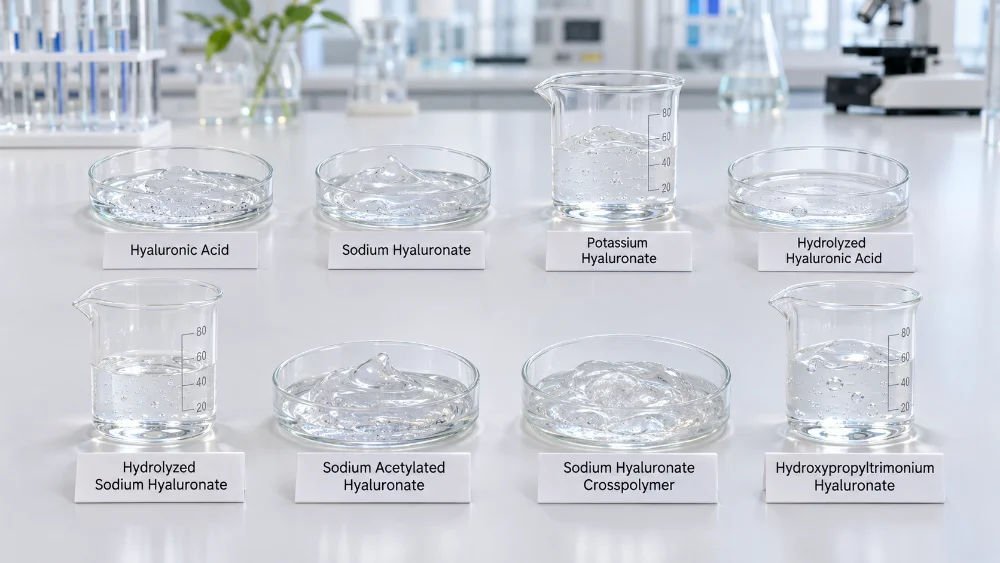
Sodium Hyaluronate and Hyaluronic Acid Salts Form the Hydration Base
Hyaluronic acid is a long sugar polymer that binds water. Most formulas use it as a salt, usually sodium hyaluronate, because it is readily water-soluble and practical for aqueous formulations, although stability depends on pH, temperature, processing and the complete formula. Potassium hyaluronate behaves in a similar way.
Suppliers offer these salts across a wide range of molecular weights. A single INCI name can cover very different grades, so the supplier specification tells a formulator far more than the label line does.
Hydrolyzed, Crosslinked and Modified HA Derivatives Serve Distinct Roles
Hydrolyzed hyaluronic acid and hydrolyzed sodium hyaluronate are broken down into smaller fragments. Formulators choose them for a lighter feel and for their interaction with the upper layers of the skin.
Sodium hyaluronate crosspolymer forms a longer-lasting gel film. Sodium acetylated hyaluronate carries acetyl groups designed to improve its affinity for skin. Hydroxypropyltrimonium hyaluronate is cationic, so it adheres to skin and hair surfaces and suits leave-on and haircare formats.
Eight names on a label can mean eight different functions. They can also mean several grades doing nearly the same job. Only the formulation brief shows which, and that is where real hyaluronic acid benefits are decided.
Hyaluronic Acid Molecular Weight Shapes Surface Hydration and Skin Interaction
Hyaluronic acid molecular weight influences how different grades interact with skin. Larger molecules primarily form a surface film, while smaller fractions may penetrate beyond the stratum corneum. The depth and biological effects depend on molecular size and formulation.
High Molecular Weight HA Hydrates at the Skin Surface
Large HA molecules stay on the skin surface. Their value comes from the water they hold and the comfort they give at the point of application.
- Film formation: High molecular weight HA forms a hydrating surface film that supports moisture retention and skin comfort.
- Water binding: Long chains hold water at the surface, giving immediate smoothness and a softer skin feel.
- Sensory limit: Higher use levels can feel tacky, so concentrations are usually kept low in serums and creams.
Low Molecular Weight HA Interacts Beyond the Skin Surface
Smaller fragments are studied for deeper interaction with skin. Much of the marketing around them still runs ahead of the published data.
- Penetration depth: Smaller HA fractions can penetrate beyond the stratum corneum, with depth varying by molecular weight and formulation.
- Biological signalling: Some cell studies link very small fragments to inflammatory responses, so grade selection needs care.
- Claim discipline: Deep hydration claims need finished-product testing to support them, beyond supplier data alone.
Molecular size gives each form its job. Pairing a surface film-former with a smaller fragment can make sense. Additional grades with overlapping functions may increase formulation complexity and cost without delivering a measurable hydration advantage. Daily hydration matters beyond formulations, especially in everyday skincare for urban living routines.
Supporting Ingredients and Formulation Design Decide Hydration Performance
HA binds water and supports hydration, but lasting moisturisation depends on the complete formula, including complementary humectants, emollients and barrier-supporting ingredients. Together, they decide how the product feels and how long hydration holds.
Complementary Humectants, Emollients and Barrier Lipids Complete the System
Glycerin, panthenol and sodium PCA add humectancy at levels HA cannot reach without turning sticky. Squalane and light esters soften skin and reduce tack. Ceramides and occlusive agents help the barrier hold water in place.
Every addition also changes the formula itself. Sodium hyaluronate thickens water, raises viscosity and can interact with electrolytes and cationic ingredients. pH, preservative choice and pack compatibility all need checking before a blend is locked, because texture is part of what the consumer judges as hydration. Hydrating formulations also support recovery phases within a structured skin cycling routine
Do more types of hyaluronic acid mean better hydration?
More types of hyaluronic acid do not automatically mean better hydration. Performance depends on each grade’s function, concentration and the overall formulation. A carefully developed two-grade formula may outperform an eight-type blend, but comparative finished-product testing is needed to establish that advantage.
Hydration performance is the result of the whole system. Supporting ingredients often do more measurable work than the third or fourth HA grade listed on the label.
Hydrating Product Development Starts With Purposeful HA Selection
For a brand, choosing HA forms is a product decision with consequences for cost, texture and claims. The right combination follows the product brief, the target skin concern and the price point. Emerging categories like neurocosmetics further demonstrate why formulation design must address specific skin concerns.
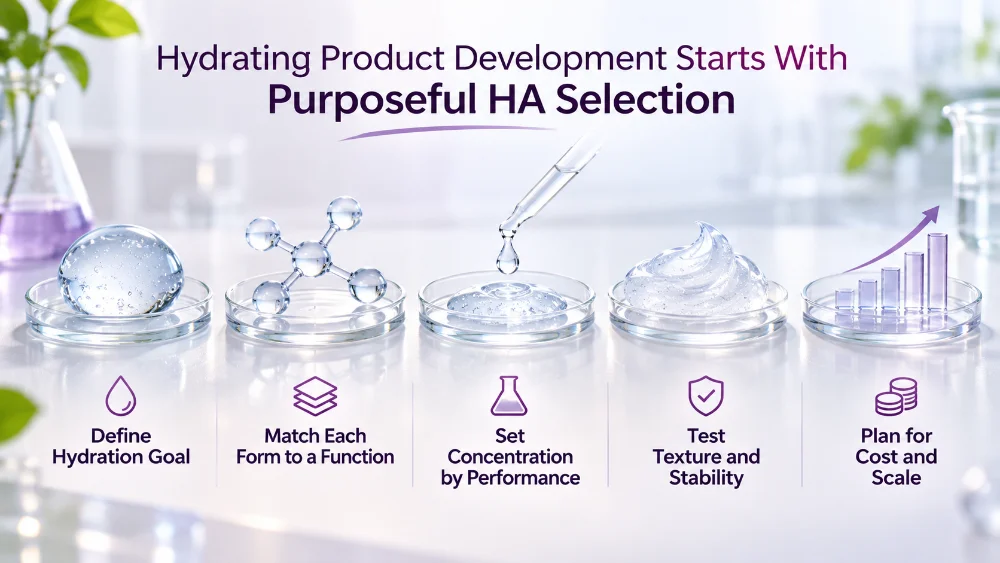
- Define the hydration goal: Choose between instant surface hydration, longer moisture retention or both before selecting grades.
- Match each form to a function: Every HA type on the INCI list needs a clear reason to be there.
- Set concentration by performance: Let formulation trials guide use levels rather than how the label reads.
- Test texture and stability: Check viscosity, tack, pH and pack compatibility under stability conditions.
- Plan for cost and scale: Specialty HA grades raise raw material cost and must behave consistently at batch scale.
At Beaucience, our R&D team evaluates HA grades, runs formulation trials and stability assessments, and supports manufacturing, so a brand’s hydration claim holds from sample to shelf.
Also Read:
- How to Start a Skincare Brand in India: A Practical Launch Roadmap
- Skincare Contract Manufacturer: What Brands Must Verify
Conclusion
The types of hyaluronic acid differ in chemistry, size and formulation role. Some hold water at the surface. Others interact with deeper skin layers or improve film and feel. Each form earns its place through function.
Ingredient count is a weak measure of performance. Concentration, raw material grade, supporting humectants and formula design decide how well a product hydrates and how it feels in daily use.
Brands that select HA with purpose build products that perform and can support their claims. That is where formulation expertise creates real differentiation on the shelf.
Developing a hydrating serum or moisturiser? Partner with Beaucience to build a formula where every HA form has a purpose.
Our Digital Imprints:
Discover the power of personalized skincare with Beaucience India. We offer premium private label skincare products and services designed for established brands, physicians, estheticians, and skincare professionals.
Beaucience is dedicated to helping brands like yours thrive in the skincare market. If you’re ready to explore custom formulations that set your products apart, we invite you to reach out and learn more about our capabilities.
Our commitment to quality ensures exceptional results tailored to your needs. Stay updated with the latest trends and insights in the beauty and cosmetic industry by subscribing to our newsletter.
“Beauty Alchemist” on Beauty and Cosmetic Industry
Join our community on : Instagram | Facebook | LinkedIn
Transform your skincare vision with Beaucience India today!