
A formula clears stability testing. The cartons are approved, and the launch date is fixed. Then a final review shows the ingredient list no longer matches the formula that passed. Few founders expect cosmetic labelling requirements to be what holds a launch back.
Many brands hand the label to design in the final week. Indian rules treat it as a regulated declaration, built from formulation, manufacturing, and pricing records that must agree with each other before print.
At Beaucience India, a leading private label cosmetic manufacturer, we specialise in bespoke skincare, haircare, and personal care formulations. Our experience in product development and manufacturing helps brands align labelling with formulation and production requirements.
In this edition, we explore what skincare brands need to get right before packaging goes to print. From labelling rules to formulation changes and manufacturing records, we examine the decisions that can affect costs, delay production, and hold back a product launch.
Also Read:
- Types of Hyaluronic Acid: Is More Really Better?
- How to Start a Skincare Brand in India: A Practical Launch Roadmap
Two Rulebooks Govern Cosmetic Labelling Requirements in India
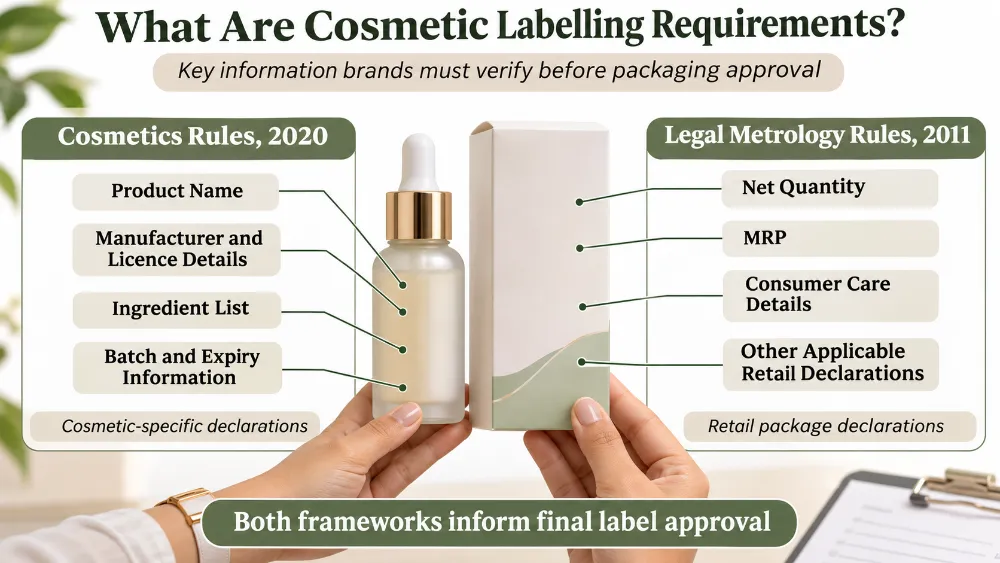
Cosmetic labelling in India is governed by two legal frameworks. The Cosmetics Rules, 2020 regulate product identification, ingredients, and safety information, while Legal Metrology rules cover retail declarations. Brands must assess both before approving packaging for sale.
Cosmetic labelling requirements are the legal rules that determine what information must appear on cosmetic packaging. In India, these include product identity, manufacturer details, ingredients, batch and expiry information, net quantity, price, and consumer disclosures under the applicable Cosmetics Rules and Legal Metrology Rules.
The Cosmetics Rules 2020 Set the Cosmetic-Specific Declarations
Rule 34 of the Cosmetics Rules, 2020 covers product names, manufacturer details, licence numbers, batch identification, ingredients and date declarations. However, not every detail belongs on both packaging layers. Some appear on inner or outer labels, while specified small packs qualify for exemptions. Relevant BIS labelling standards may also apply.
The Cosmetics (Amendment) Rules, 2025 clarified an important distinction. “Use before 12/2027” means before 1 December 2027, while “Date of expiry 12/2027” means the product expires on 31 December 2027. Brands must choose wording consistent with the applicable rules and supported shelf life.
Beyond label declarations, understanding regulatory compliance for skincare brands helps connect product safety, manufacturing standards, and market readiness.
The Legal Metrology Rules Govern Retail Package Declarations
The Legal Metrology (Packaged Commodities) Rules, 2011 govern retail information, including manufacturer, packer or importer details, product identity, net quantity, MRP inclusive of taxes, consumer care information and unit sale price where applicable. Imported products also require applicable origin declarations. These requirements affect cosmetic packaging labels before commercial printing.
Date declarations require particular care. Cosmetics follow their specific date requirements rather than the general Legal Metrology manufacturing-date declaration. Different pack sizes also require separate checks. A 30 ml serum, 10 ml travel pack and promotional kit should not automatically share identical artwork or rely on the same exemptions.
For brands, compliance means more than having the correct information. Each declaration must match the actual product, packaging format and applicable rule before artwork receives final approval.
Product Declarations Must Match Verified Manufacturing Records
Accurate cosmetic packaging labels depend on more than correct text. Every declaration must match the approved formulation, manufacturing licence, packaging specifications, and pricing records before artwork is released for commercial printing.
Cosmetic Ingredient Labelling Must Mirror the Approved Formula
A brand may approve its ingredient list before the final formulation is locked. If R&D later changes an active concentration or replaces a fragrance, the ingredient declaration must be reviewed again.
- Ingredient nomenclature: Verify recognised ingredient names against the approved formula and applicable labelling standards.
- Declaration order: List ingredients above 1% in descending order, followed by those at or below 1% in any order, subject to applicable exemptions.
- Formula change control: Review ingredient declarations whenever formulation changes affect the approved artwork.

Product Identity and Commercial Details Require Separate Verification
Not every label declaration comes from the manufacturing record. Manufacturer identity, pack quantity, retail price, and batch details have different sources that must be checked before approval.
- Manufacturer identification: Match the declared manufacturer name, address, and licence number with approved regulatory records.
- Quantity and pricing: Verify net quantity against packaging specifications and MRP against authorised pricing records.
- Batch and date coding: Confirm applicable date wording, batch identification, and coding arrangements against production requirements.
In private label cosmetic manufacturing, coordination between brand owners and manufacturers is essential for accurate product documentation and packaging approval.
A formulation change after artwork approval can make printed packaging unsuitable for use. Linking technical records with final label approval helps brands avoid unnecessary reprints, added costs, and production delays.
Claims and Artwork Decide Whether Cosmetic Packaging Labels Hold Up
Approving cosmetic packaging labels is also a financial commitment. Once cartons, labels, or containers are ordered, incorrect declarations or unsupported claims can lead to packaging waste, additional costs, and delayed product launches.
Artwork Must Carry Every Declaration Across Primary and Secondary Packs
A 30 ml serum bottle and its outer carton have different space constraints. Brands must determine which declarations belong on each packaging layer under applicable rules. Changes in pack size or design may require another compliance review.
Consider a brand that has ordered 20,000 printed cartons. An incorrect manufacturer address or unsupported claim could require costly revisions. Where declarations appear on both packaging layers, they must remain consistent and legible.
Can a Cosmetic Label Carry Treatment or Therapeutic Claims?
Rule 36 of the Cosmetics Rules, 2020 prohibits false or misleading cosmetic claims. Claims suggesting treatment or cure of medical conditions may raise drug classification concerns. Brands must verify the product’s intended purpose and supporting evidence before approving artwork.
Emerging categories such as neurocosmetics in skincare highlight why brands must distinguish scientific ingredient research from claims supported by the finished product.
Claims review and artwork approval must happen before packaging orders are placed. This protects the brand’s packaging investment, reduces reprint costs, and prevents avoidable delays in commercial production.
Final Label Approval: Five Checks Before Packaging Goes to Print
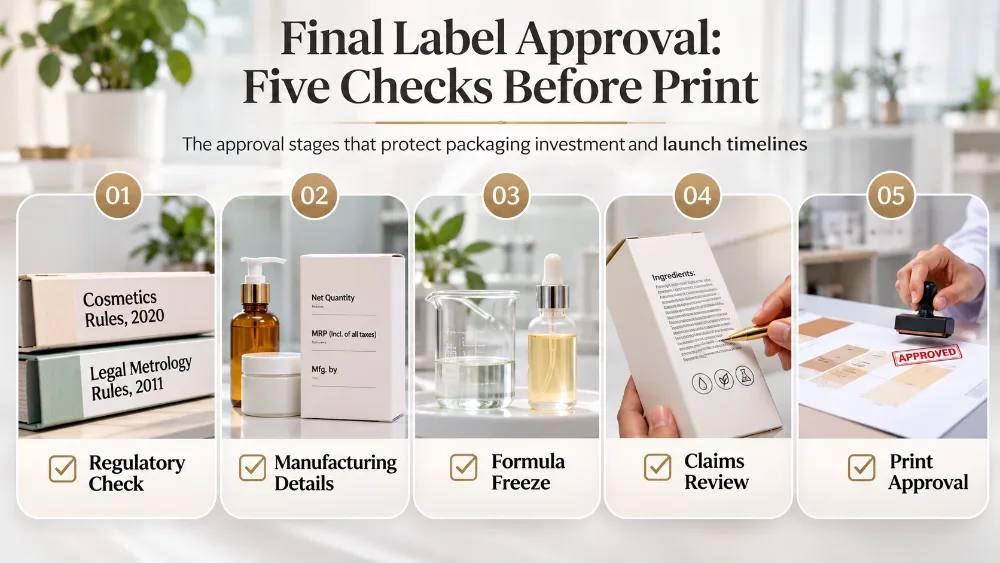
For skincare founders and business heads, final artwork approval is a commercial decision. These five checks help protect packaging investment, reduce production delays, and prevent costly corrections after printing.
- Confirm regulatory compliance: Verify applicable cosmetic labelling requirements, pack-specific declarations, and exemptions before approving artwork.
- Validate manufacturing details: Match manufacturer identity, licence information, net quantity, and MRP with approved records.
- Freeze the formulation: Confirm the final ingredient list and assess any formula changes before releasing packaging for print.
- Clear product claims: Ensure marketing promises reflect the finished formula, supporting evidence, and applicable cosmetic regulations.
- Authorise printing: Obtain documented approval from brand, technical, and regulatory reviewers before placing commercial packaging orders.
A label approved too early can turn a small correction into wasted inventory and delayed sales. The final print approval should be treated as a controlled business decision, not a routine design sign-off.
Also Read:
- Skincare Contract Manufacturer: What Brands Must Verify
- Peptides in Skincare: What Formulation Science Has to Get Right
Conclusion
Cosmetic labelling requirements in India go beyond meeting regulatory obligations. Every declaration must reflect the approved formulation, manufacturing records, and commercial details. For skincare brands, early label approval helps prevent costly packaging errors, production delays, and unnecessary reprints.
At Beaucience India, we bring together R&D expertise, bespoke formulation development, and private label manufacturing. By coordinating technical documentation, packaging requirements, and production details, we help beauty brands make informed decisions before committing to commercial packaging.
A successful product launch depends on more than a quality formulation. When founders treat labelling as part of product development, they protect their investment, strengthen consumer trust, and bring products to market with greater confidence.
Preparing your next skincare launch? Partner with Beaucience for formulation development, packaging support, and reliable private label manufacturing.
Our Digital Imprints:
Discover the power of personalized skincare with Beaucience India. We offer premium private label skincare products and services designed for established brands, physicians, estheticians, and skincare professionals.
Beaucience is dedicated to helping brands like yours thrive in the skincare market. If you’re ready to explore custom formulations that set your products apart, we invite you to reach out and learn more about our capabilities.
Our commitment to quality ensures exceptional results tailored to your needs. Stay updated with the latest trends and insights in the beauty and cosmetic industry by subscribing to our newsletter.
“Beauty Alchemist” on Beauty and Cosmetic Industry
Join our community on : Instagram | Facebook | LinkedIn
Transform your skincare vision with Beaucience India today!