
Most skincare brand founders I speak with are running the same loop. Ad spend goes up. Creatives get refreshed. Audiences are re-segmented. And at the end of every month, the cost per purchase is higher than it was the month before. Recent industry data shows over 60 percent of skincare brands report rising acquisition costs despite increased spend. The instinct is to treat this as a media problem — to find better channels or lower CPMs. In most cases, that instinct is wrong. This is why building effective skincare products with real performance is harder than scaling ads
At Beaucience India, we work with skincare brands from formulation to scaled manufacturing. What we observe consistently is simple. Acquisition cost problems trace back to decisions made before the campaign ever ran.
Most ranges are built reactively. Products accumulate without architecture or category logic. The result is a collection, not a brand. This is also why skincare results not working remains a common consumer concern.
This article explains how formulation strategy drives outcomes and why effective skincare products are built upstream.
Also Read:
- Hyperpigmentation Treatment Using Tranexamic Acid and Multi-Active Brightening Systems
- Skin Barrier Repair Products for Sensitive Skin
Why Effective Skincare Products Fail Without Clear Positioning
Effective skincare products fail when they lack clear differentiation at the formulation level, forcing brands to rely on paid media instead of product performance to drive conversions.
Effective skincare products are defined by formulation clarity, ingredient compatibility, and structured usage systems. Without these, products rely on marketing instead of performance, reducing long-term results and repeat purchase.
Undifferentiated skincare products create a specific and expensive problem. When a product cannot communicate its own value, conversion depends entirely on paid media — and that is a cost that does not go away. This is where skincare product effectiveness directly impacts brand performance.
How Undifferentiated Products Create Paid Acquisition Dependency
The skincare market is not short of options. In most categories — serums, moisturisers, cleansers, SPFs — consumers face a wide field of products with similar claims, similar packaging, and similar price points. Without a clear formulation-backed differentiator, the only thing that makes one product more visible than another is paid media.
This dynamic is expensive in a specific way. Undifferentiated products produce low conversion rates, which force brands to buy more impressions to generate the same number of purchases. Higher impression volumes raise CPM. CPM increases raise CPC. CPC increases raise the cost per purchase. This cycle repeats every quarter, and no amount of creative optimisation resolves it — because the problem is not in the campaign. It is in the product.
What Product Positioning Means for Skincare Product Effectiveness
Positioning is not a tagline. It is the answer to a question a consumer asks without saying it aloud: why does this product work differently? When that answer lives inside the formulation — in an active system validated to deliver a specific outcome, a delivery mechanism matched to the skin concern, or a product architecture that addresses something competitors have not — the conversion argument does not require constant ad reinforcement.
Brands that build positioning into formulation from the brief stage earn a durable commercial advantage. A ceramide repair cream with a validated TEWL reduction claim commands a different conversion rate and a different price ceiling than a generic moisturiser labelled “deeply hydrating.” This is also critical for consumers trying to understand how to choose skincare productsina crowded market.
Product positioning that lives in formulation reduces paid acquisition dependency structurally. It is not a marketing asset — it is an economic one, and it compounds over time. This is why effective skincare products are defined by formulation clarity, not visibility.
How Skincare Product Ranges Impact Effectiveness and Repeat Purchase
Skincare product effectiveness declines when ranges lack clear structure, making it difficult for consumers to build routines and see consistent results.
When a skincare range is built without category logic, consumers cannot form a routine around it. No routine means no repeat purchase — and every repurchase becomes a new acquisition event.
Category Clarity as a Driver of Skincare Product Effectiveness
Category clarity defines how each product fits into a routine. Without this structure, consumers struggle to understand usage, reducing consistency and weakening overall skincare product effectiveness.
- Defined product roles: Each product serves a clear function within a routine
- Logical sequence: Cleanser, treatment, repair, protect creates usage clarity
- Improved consistency: Structured routines increase adherence and results
- Higher trust: Clear systems signal formulation expertise to users
- Better outcomes: Routine-based usage improves skincare product effectiveness
- Simpler decisions: Helps consumers understand how to choose skincare products
The retention economics are direct. A consumer in a routine repurchases predictably and repeatedly. The cost of retaining them is marginal.
How Fragmented Ranges Reduce Skincare Results
Fragmented ranges force consumers to evaluate each product independently. This breaks continuity, reduces routine adoption, and leads to inconsistent usage and weaker results over time.
- Isolated SKUs: Products compete instead of supporting each other
- Repeated acquisition: Brands pay multiple times for the same customer
- Low retention cycles: No routine leads to inconsistent repurchase behavior
- Confused usage: Consumers unsure how products fit together
- Weaker outcomes: Contributes to skincare results not working for many users
- Reduced differentiation: Products fail to stand out in saturated categories
Brands with clear category architecture convert one acquisition event into a multi-product routine. A consumer who adopts a routine repurchases across the range without paid prompting.
Category clarity is not a UX problem. It is a revenue architecture decision that determines how much a brand pays — repeatedly — for the same consumer, and why effective skincare products depend on structured systems.
Why Formulation Architecture Defines Effective Skincare Products
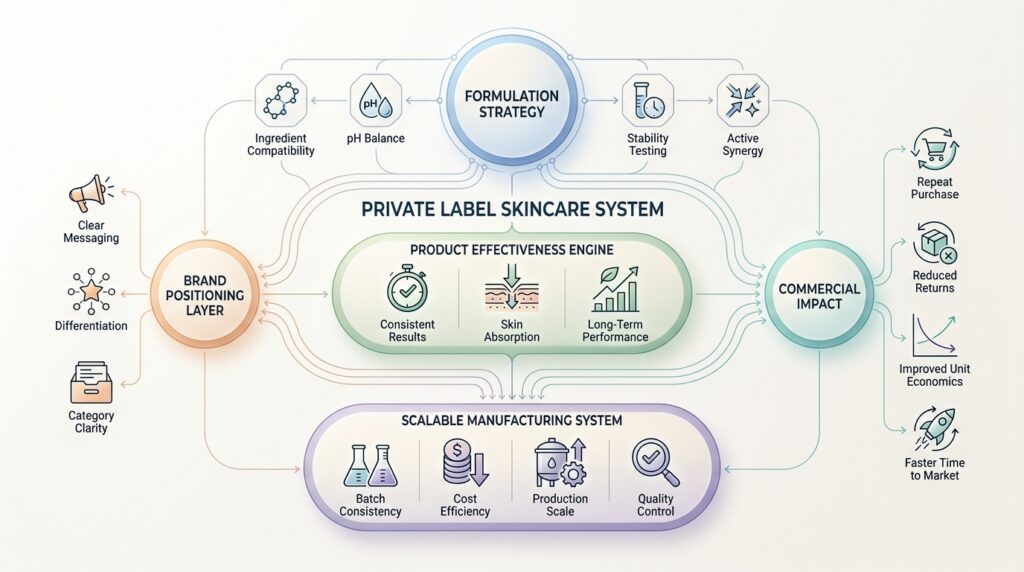
Effective skincare products are built through structured formulation systems. Without this, even strong ingredients fail to deliver consistent results, reducing skincare product effectiveness and long-term consumer trust.
How Structured Formulation Improves Skincare Product Effectiveness
Most brand founders treat formulation as a production task — something briefed after positioning and packaging. This approach fails because ingredient selection, concentration, and delivery must work as one system. When aligned, products deliver consistent results across usage cycles, helping consumers understand how to choose skincare products that actually perform.
Why Do Ingredient-Led Skincare Products Fail
Ingredient-led products fail because they are built around trends, not outcomes. Without formulation architecture, results do not sustain, which is why skincare results not working remains a common consumer concern.
Formulation architecture is a financial decision dressed in chemistry. Brands that treat it as such build effective skincare products that convert, retain, and reduce long-term acquisition dependency.
How Private Label Skincare Improves Product Effectiveness and Scale
Effective skincare products require more than good ingredients. Private label skincare partners enable structured formulation, better positioning, and scalable systems that improve skincare product effectiveness and long-term brand performance.
How Private Label Partners Improve Skincare Product Effectiveness
Working with a formulation partner changes more than product quality. It improves how products are designed, validated, and scaled for consistent results.
- Lower cost per SKU at validated quality: In-house R&D ensures formulations pass stability testing early, reducing delays and improving time-to-market efficiency
- Positioning built at the brief stage: Differentiation is defined before production, improving skincare product effectiveness without relying on marketing correction
- Category architecture as a system: Structured ranges help consumers understand how to choose skincare products and build repeatable routines
- Scalable unit economics: Manufacturing at scale reduces cost per unit while maintaining consistent formulation performance
- Reduced reformulation and returns: Stability-driven systems minimise product failure and reduce instances of skincare results not working
Private label economics work when formulation strategy is resolved upstream. Brands that treat manufacturing as a strategic input build effective skincare products that scale, convert, and retain without repeated acquisition dependency.
Also Read:
- Dandruff Formulation: Why Scalp Imbalance Causes Flakes
- How Skin Barrier Repair Formulations Restore Dry and Compromised Skin
Where Skincare Results Begin
Effective skincare products are not created through marketing optimisation. They are built through formulation strategy that aligns positioning, performance, and long-term skincare product effectiveness.
When products lack differentiation, brands are forced to repeatedly acquire the same customer. This is why skincare results not working continues to be a widespread concern. Structured formulation systems solve this by improving consistency, enabling routine adoption, and helping consumers understand how to choose skincare products that deliver results.
Brands that scale sustainably focus on formulation architecture, not just visibility. They build effective skincare products that convert once and retain over time, reducing dependency on paid acquisition.
Partner with Beaucience to develop effective skincare products designed for performance, clarity, and scale through structured formulation systems and private label expertise.
Our Digital Imprints:
Discover the power of personalized skincare with Beaucience India. We offer premium private label skincare products and services designed for established brands, physicians, estheticians, and skincare professionals.
Beaucience is dedicated to helping brands like yours thrive in the skincare market. If you’re ready to explore custom formulations that set your products apart, we invite you to reach out and learn more about our capabilities.
Our commitment to quality ensures exceptional results tailored to your needs. Stay updated with the latest trends and insights in the beauty and cosmetic industry by subscribing to our newsletter.
“Beauty Alchemist” on Beauty and Cosmetic Industry
Join our community on : Instagram | Facebook | LinkedIn
Transform your skincare vision with Beaucience India today!