
A skincare brand can look ready for launch long before the product exists. The logo is final, packaging designs are approved, and launch dates are announced. Yet the most important question remains unanswered: What exactly are you selling? This is where many plans for how to start a skincare brand begin to unravel.
India’s beauty and personal care market is projected to reach USD 40 billion by 2030. This growth creates opportunities for everyday skincare brands. Yet market potential alone cannot guarantee success. Product differentiation, formulation feasibility, regulatory compliance and manufacturing economics determine launch readiness.
At Beaucience India, our experience in custom formulation, in-house R&D and contract manufacturing gives us direct insight into what it takes to develop market-ready skincare. From ingredient selection and stability testing to packaging compatibility and production, every stage requires scientific precision and commercial planning.
In this edition, we explore the practical roadmap from business concept to market-ready product. You will understand launch models, product development, testing, packaging, investment considerations and common planning mistakes, helping you make informed decisions before committing time and capital.
Also Read:
- Peptides in Skincare: What Formulation Science Has to Get Right
- Skincare Contract Manufacturer: What Brands Must Verify
Market Positioning Defines Skincare Brand Success
India’s skincare market recorded 13% value growth reaching ₹32,210 crore in retail sales. As competition intensifies across mass, masstige and premium segments, identifying unmet consumer needs becomes essential for meaningful product differentiation.
Starting a skincare business in India requires four fundamental decisions: identifying the target consumer, selecting a product category, defining meaningful differentiation and establishing a viable price segment. Together, these decisions guide product formulation, packaging selection, manufacturing requirements and initial investment planning. Skin cycline routine creates enough opportunities.
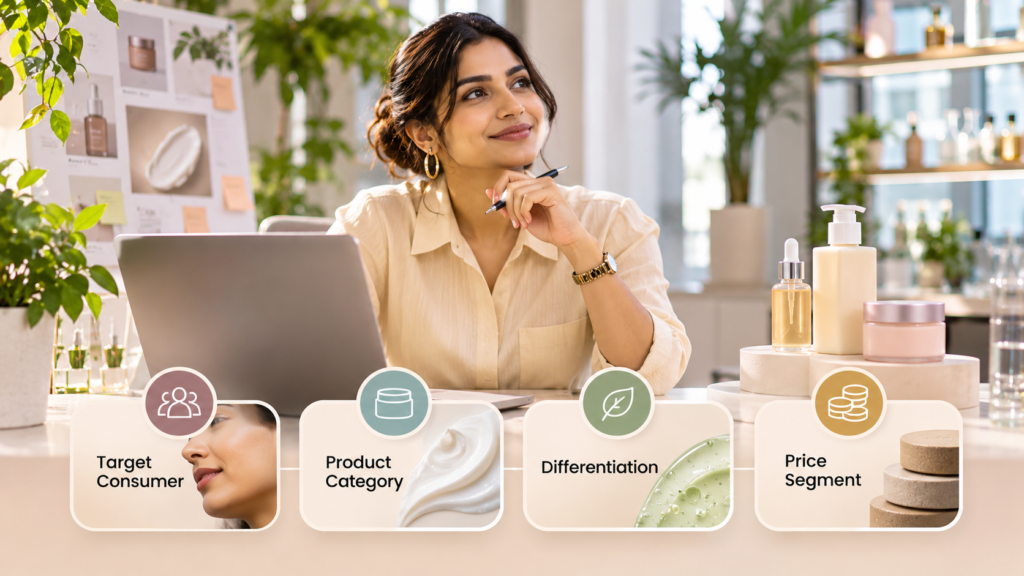
Target Consumer, Category and Differentiation Define the Product Brief
Start with who the product is for and which concern it addresses. Oily, acne-prone skin in humid Mumbai asks for a different texture than dry winter skin in Delhi. Differentiation has to be deliverable through formulation, texture or format. A claim added at the artwork stage cannot be engineered backwards into the bottle.
A focused hero product, or a small range of two or three, is easier to develop and launch well. Every added SKU multiplies sample rounds, stability work and packaging decisions. The answers to these questions become the product brief our R&D team works from.
Pricing Segment and Investment Decide What Can Be Built
Ingredient budgets, packaging expectations and margins differ across mass, masstige and premium skincare segments. Skincare formulation must balance ingredient performance, stability and commercial feasibility without compromising product quality.
Cosmetic manufacturing costs depend on formulation complexity, order quantities, packaging specifications and production requirements. Founders must evaluate these variables against their intended retail price and expected margins.
A commercially realistic budget gives R&D clear development boundaries and helps prevent costly revisions before manufacturing begins.
Private Label, Custom Formulation and Third-Party Manufacturing Suit Different Brands
The launch model decides speed, cost, ownership and how distinct the product can be. It is a commercial choice first, matched to the brand’s timeline, budget and the degree of differentiation it needs.
Private Label Skincare in India Offers Speed and Proven Platforms
Private label skincare in India adapts an existing, tested formulation platform to a brand’s identity. For first-time founders, that shortens development and lowers early risk.
- Proven base formulations: Existing formulation platforms may reduce development time, although customisation and final packaging still require appropriate stability and compatibility evaluation.
- Faster market entry: Customisation centres on fragrance, texture adjustments, packaging and brand identity.
- Lower development cost: Reduced R&D spend leaves more budget for packaging and launch marketing.
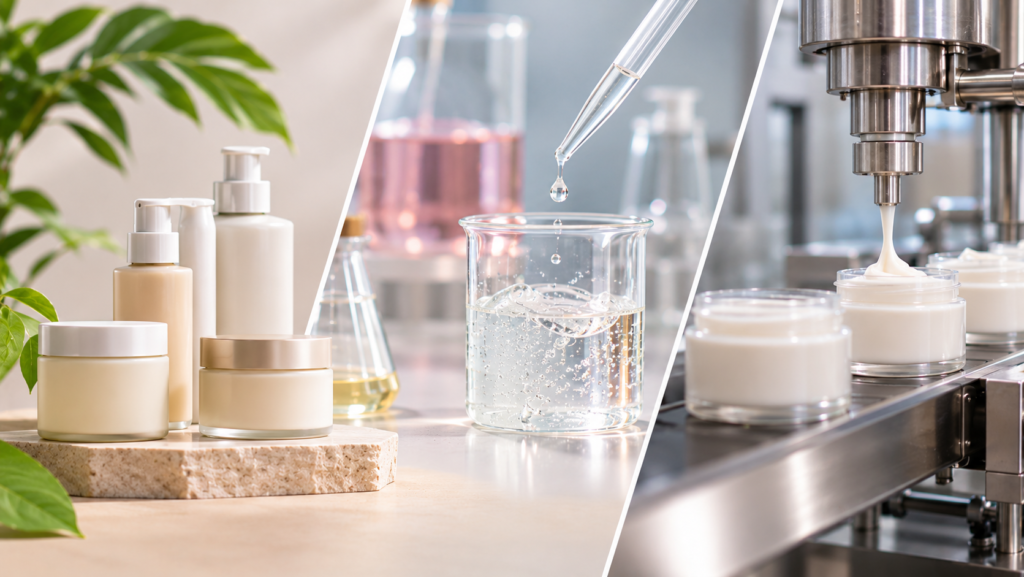
Custom Formulation and Third-Party Manufacturing Build Distinct Products
Custom formulation develops a product around a brand’s specific requirements. Third-party manufacturing involves production by an external manufacturer, using either an existing formulation or a separately developed one. Formula ownership depends on the agreed commercial terms. Both routes require careful development and production planning.
- Formulation ownership: A formula built around chosen actives, concentrations and sensorials creates real differentiation.
- Longer development cycle: Multiple sample rounds and fresh stability evaluation extend the overall timeline.
- Technology transfer: A brand-owned formula needs scale-up, raw material matching and process validation.
No route is better in absolute terms. The right one matches what the brand must be different on, and what it can invest to get there.
Steps to Start a Skincare Brand From Product Brief to Launch Approval
A concept becomes launch-ready only after it is formulated, tested, packed and documented. Each of these steps can push a launch date back when it starts late.
Development, Stability and Packaging Compatibility Decide Launch Readiness
The brief moves into ingredient selection and the first R&D sample. Founders review texture, fragrance and skin feel, and the formula is refined over one or more rounds. Our team then runs stability evaluation under accelerated and real-time conditions, checking that pH, viscosity, colour and odour hold. Final approval comes only when the data supports it.
Stability must also be confirmed in the final pack. A vitamin C serum built on ascorbic acid oxidises faster in a pack that admits air or light, so the container is part of the formulation decision. Alongside this sit the manufacturing licence under the Cosmetics Rules, 2020, product documentation, compliant labelling and batch quality checks before release.
How long does it take to start a skincare brand in India?
There is no fixed timeline. Duration depends on launch route, formulation complexity, sample rounds, stability evaluation, packaging lead times and order size. Private label routes generally move faster than custom formulation because tested platforms already exist.
Launch dates hold when testing, packaging and documentation run alongside development instead of waiting for it to finish. Sequencing is where most delays are created or prevented.
A Successful Skincare Brand Launch Starts With the Right Manufacturing Partner
At Beaucience India, our experience with emerging and established beauty brands shows how an experienced cosmetic manufacturing partner integrates product development, quality standards and production planning for successful skincare launches.
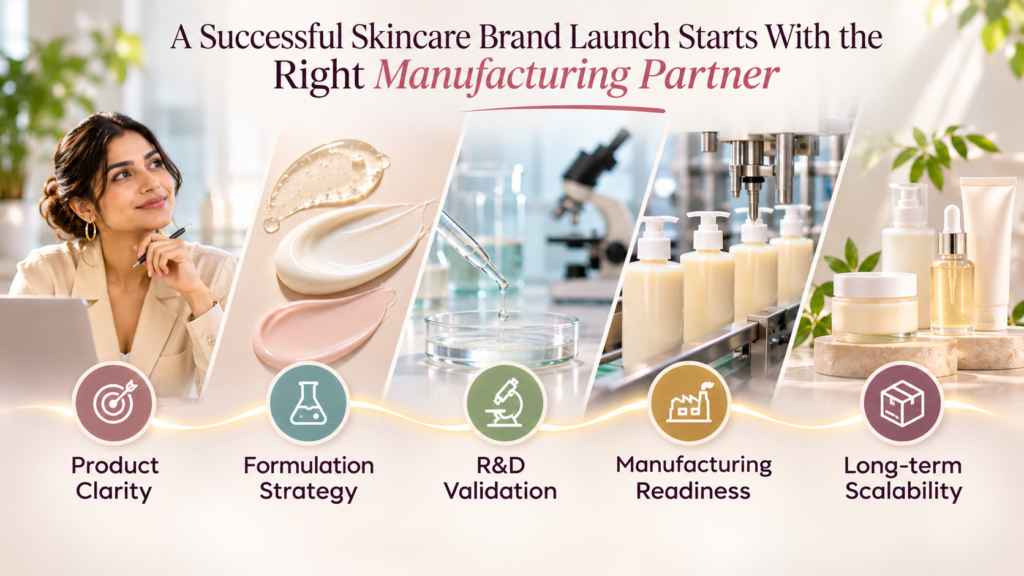
- Product clarity: Begin with a defined consumer, product concept, positioning and commercial objective before committing resources.
- Formulation strategy: Choose private label or custom formulation based on differentiation, development requirements and investment capacity.
- R&D validation: Evaluate samples, stability, performance and packaging compatibility before approving a product for manufacturing.
- Manufacturing readiness: Align documentation, quality requirements, production capacity and packaging availability before confirming launch commitments.
- Long-term scalability: Build products that can maintain consistent quality and consumer experience as orders and distribution expand.
At Beaucience, our role extends beyond manufacturing a skincare product. We help brands connect their vision with formulation science, quality systems and production capabilities, creating a stronger foundation for a commercially viable launch.
Also Read:
- Scalp Care Formulation Beyond Shampoo: What Brands Need to Get Right
- Cosmetic Raw Materials: Quality, Stability and Performance
Conclusion
Learning how to start a skincare brand is mostly learning which decisions to make early. Consumer, category, differentiation, price and launch route shape everything the lab and the factory do afterwards.
When formulation, testing, packaging, compliance and cost are resolved together, budgets and launch dates hold. Solved one at a time after commitments are made, each fix reopens the one before it.
The founders who move fastest arrive with a concept, an intended market and realistic launch expectations, then work with a partner who can develop and manufacture under one roof.
Planning your skincare launch? Share your product concept with Beaucience and build a formulated range ready for market.
Our Digital Imprints:
Discover the power of personalized skincare with Beaucience India. We offer premium private label skincare products and services designed for established brands, physicians, estheticians, and skincare professionals.
Beaucience is dedicated to helping brands like yours thrive in the skincare market. If you’re ready to explore custom formulations that set your products apart, we invite you to reach out and learn more about our capabilities.
Our commitment to quality ensures exceptional results tailored to your needs. Stay updated with the latest trends and insights in the beauty and cosmetic industry by subscribing to our newsletter.
“Beauty Alchemist” on Beauty and Cosmetic Industry
Join our community on : Instagram | Facebook | LinkedIn
Transform your skincare vision with Beaucience India today!